

CNC Machining Aluminum 6061: A Complete Guide
CNC machining Aluminum 6061 is a top choice for creating strong, lightweight, and cost-effective parts. This guide covers the essential knowledge you need for achieving high-quality results with this versatile alloy.
In this article, you will learn about 6061's properties, key machining considerations, and popular applications. We will explore best practices for tooling, speeds, and finishing options to optimize your projects.
What is Aluminum 6061?
Aluminum 6061 is a precipitation-hardened aluminum alloy. Its main alloying elements are magnesium and silicon. It is one of the most common aluminum alloys for general-purpose use. Its combination of properties makes it extremely versatile.
You can find it used in everything from bicycle frames to aircraft structures. Its popularity stems from its excellent mechanical properties and ease of manufacturing.
Key Properties of 6061
Understanding the properties of 6061 aluminum helps you leverage its full potential. It offers a great balance of strength, corrosion resistance, and machinability.
- Excellent Machinability: It allows for high cutting speeds, producing a good surface finish.
- Good Strength-to-Weight Ratio: It provides significant strength without adding excessive weight.
- High Corrosion Resistance: It holds up well against atmospheric conditions and other corrosive elements.
- Weldability and Formability: It can be easily welded and formed into complex shapes.
Understanding T6 Temper
You will often see this alloy specified as 6061-T6. The "T6" refers to its temper, or the heat treatment process it has undergone.
The T6 temper involves solution heat-treating the aluminum and then artificially aging it. This process significantly increases its strength and hardness. For instance, the ultimate tensile strength of 6061-T6 is approximately 45,000 psi (310 MPa), making it ideal for structural applications.
Why Choose 6061 for CNC Machining?

For engineers and designers, 6061-T6 is a go-to material for CNC machined prototypes and end-use parts. Its predictable and stable behavior during machining reduces production time and costs.
The material's excellent thermal conductivity helps dissipate heat quickly during cutting. This minimizes tool wear and reduces the risk of part deformation. Its affordability compared to higher-strength alloys like 7075 makes it a practical choice for a wide range of budgets.
Key Machining Considerations
To get the best results when CNC machining aluminum 6061, you must control several key variables. Proper setup prevents common issues like built-up edge (BUE) and poor surface finish.
Optimal Speeds and Feeds
Aluminum 6061 can be machined at very high speeds. High spindle speeds (RPM) and fast feed rates are typical. This allows for rapid material removal and shorter cycle times.
However, the ideal settings depend on the machine, tool, and depth of cut. A good starting point for carbide tools is often in the range of 1,000 to 4,000 Surface Feet per Minute (SFM). Always consult a machinist's handbook for precise calculations.
Choosing the Right Tools
The right cutting tool is critical for success. While High-Speed Steel (HSS) can be used, carbide tools are highly recommended for their superior performance and tool life.
- Flutes: Use 2 or 3-flute end mills. This provides ample room for chip evacuation, which is crucial with aluminum.
- Coatings: Uncoated, polished carbide tools are often preferred. Coatings like TiN or TiCN can sometimes cause aluminum to stick to the tool. Zirconium Nitride (ZrN) is an excellent coating option for aluminum.
- Helix Angle: High helix angles (around 35°-45°) help pull chips away from the cutting zone effectively.
Coolant and Chip Evacuation
Proper coolant use is non-negotiable. Coolant lubricates the cutting tool, washes away chips, and prevents the material from overheating. A flood coolant system using a water-soluble oil emulsion is standard.
Good chip evacuation prevents chips from being re-cut, which can damage the part surface and break the tool. High-pressure through-spindle coolant systems are extremely effective for this purpose.
Common CNC Machining Processes

Aluminum 6061 is well-suited for various CNC machining operations. Its consistent properties make it reliable for both simple and complex geometries.
CNC Milling Aluminum 6061
In CNC milling, 6061-T6 cuts cleanly, allowing for fine details and tight tolerances. It is easy to achieve excellent surface finishes, often under 63 micro-inches Ra. The material's stability means minimal warping or distortion on complex parts.
CNC Turning Aluminum 6061
CNC turning 6061 on a lathe is also straightforward. The material produces predictable, manageable chips. It enables high cutting speeds, resulting in efficient production of round and cylindrical parts with a smooth finish.
Popular Finishing Options
After machining, you can apply several surface finishes to enhance the part's appearance, durability, or corrosion resistance.
- Anodizing (Type II & Type III): This is the most common finish for 6061. It creates a hard, corrosion-resistant oxide layer. Type II allows for dyeing in various colors, while Type III (hardcoat) provides superior wear resistance.
- Bead Blasting: Creates a uniform matte or satin texture.
- Powder Coating: Applies a durable, protective, and decorative polymer finish.
- Polishing: Achieves a smooth, reflective mirror-like finish.
Applications of Machined 6061 Parts
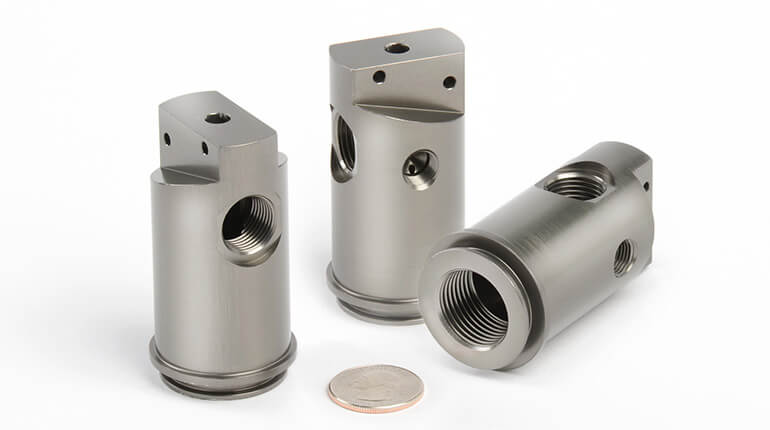
Thanks to its balanced properties, you will find CNC machined 6061 aluminum in nearly every industry.
- Aerospace: Non-critical aircraft components and structural fittings.
- Automotive: Custom parts, brackets, and suspension components.
- Consumer Electronics: Housings for laptops, phones, and audio equipment.
- Sporting Goods: Bicycle frames, rock climbing gear, and firearm components.
- Robotics & Automation: Structural frames and custom machinery parts.
Overcoming Machining Challenges
While 6061 is easy to machine, one common challenge is the "gummy" nature of aluminum. This can lead to a built-up edge (BUE) on the cutting tool. BUE occurs when small particles of the material weld themselves to the tool tip.
This issue degrades surface finish and can lead to tool failure. You can prevent it by using sharp tools with high rake and clearance angles, applying ample coolant, and maintaining high cutting speeds.
Standard Machining's Aluminum 6061 Machining Services
At Standard Machining, we specialize in high-precision CNC machining of aluminum 6061. Our state-of-the-art equipment and experienced team can handle projects of any complexity, from rapid prototypes to full production runs.
We understand the unique properties of 6061-T6 and optimize every step of the process. We deliver parts that meet your exact specifications with fast turnaround times and consistent quality.
Conclusion
Aluminum 6061-T6 is an outstanding material for CNC machining. Its blend of strength, workability, and cost-effectiveness makes it an industry staple. By understanding its properties and applying proper machining techniques, you can produce high-quality, reliable parts for any application.
If you need expert CNC machining for your 6061 aluminum parts, Standard Machining is here to help. Our advanced capabilities and experienced team ensure precision and quality on every project. Contact us today for a quote.
FAQs
1. What is the difference between aluminum 6061 and 7075?
Aluminum 6061 is a versatile, general-purpose alloy with good corrosion resistance and weldability. Aluminum 7075 is significantly stronger and harder but is more expensive, less corrosion-resistant, and is generally not considered weldable. You would choose 7075 for high-stress applications like critical aerospace components.
2. Is aluminum 6061 difficult to machine?
No, quite the opposite. Aluminum 6061 is considered one of the most machinable alloys available. Its soft, consistent nature allows for high-speed cutting and results in an excellent surface finish, provided the correct tools, speeds, and coolants are used.
3. Can you weld 6061 aluminum?
Yes, 6061 aluminum is highly weldable. Common methods like TIG (Tungsten Inert Gas) and MIG (Metal Inert Gas) welding produce strong, reliable joints. However, be aware that welding will anneal (soften) the material in the heat-affected zone, reducing the strength gained from the T6 temper. A post-weld heat treatment may be needed to restore its strength.
4. Why is anodizing a popular finish for 6061 parts?
Anodizing is popular because it dramatically improves the natural corrosion and wear resistance of aluminum 6061. The process also creates a porous surface that is excellent for accepting dyes, allowing you to add a durable, colored finish to your parts for aesthetic or functional purposes.


Recent Posts

LET’S START WORK
TOGETHER
Please feel free to contact us. We will get back to you with 1-2 business days. Or just call us now.